Body

The Environmental Sustainability major brings together the natural sciences, social sciences, and cutting-edge data tools to help students understand how the Earth works—and how we can care for it. Students explore everything from biodiversity, ecology, and climate processes to the forces that shape landscapes, oceans, and weather. Whether you’re studying the emergence of life, tracking severe storms, or examining how rivers, hazards, and resources evolve, you’ll gain a deep foundation in the interconnected systems that sustain our planet.

Beyond the physical sciences, the major also examines how people, places, and policies influence environmental outcomes. Courses in environmental economics, global food systems, sustainability planning, environmental writing, and the human dimensions of climate change give students the tools to create meaningful change in communities and organizations. With advanced options in GIS, remote sensing, restoration ecology, energy systems, and more, the major empowers students to tailor their path and prepare for careers across science, policy, communication, and sustainability practice. Explore the full list of offerings to see how the curriculum can fit your interests and goals.

The natural history building at sunset.

Fall 2026 Major Courses

See what courses are available in Fall 2026!

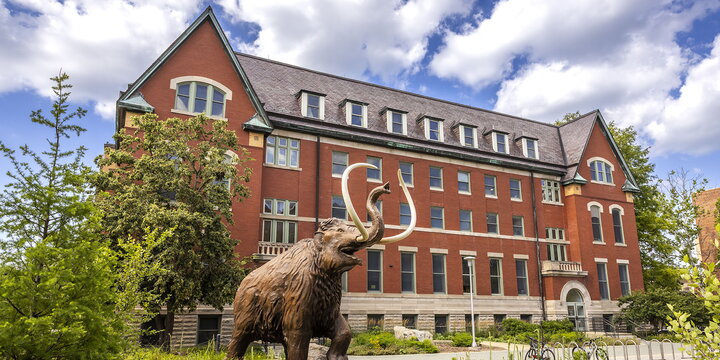
The natural history building and the mammoth on a sunny day.

Questions About the Major?

Do you have questions about the major? Start here.

An upshot of the mammoth with Noyes Lab in the background on a sunny day.

Talk to an advisor

Still have questions? Schedule an appointment with an advisor!

Outline of the ES Bachelor of Science in Liberal Arts and Sciences

Body

The ES program offers a unique combination of structure and flexibility not found in most programs at the University of Illinois. Since most students are not accustomed to the level of choice we offer in our majors, the ES program has professors ready to advise you on tailoring your degree.

One Concentration (18-22 hours)

  • Society and Environment (SAE) OR
  • Science of the Earth System (SES)

ES Introductory Core: Required Courses (10 hours)

  • ESE 200: Earth's Physical Systems
  • ENSU 300: Environmental Sustainability
  • ESE 379: Intro to GIS Systems

ES Advanced Courses (18-24 hours)

  • Six advanced courses from the approved list, four must be from the ESE or ENSU rubric.

Choose a Concentration

After studying cross-disciplinary introductory classes, ESES students choose to focus in one of two concentrations, depending on their developing interests.

Title
SAE: Society and Environment, 18 - 21 Hours
Body

Substitutions may be made with advisor approval.

The SAE concentration offers a balanced cross-disciplinary social science/humanities education, emphasizing the political, socio-cultural, economic, and historical dimensions of sustainability. Students in this track might be interested in focusing on these areas:

  • Environmental Policy
  • Environmental Economics
  • Studies in Science and Technology
  • Social Valuation of Environmental Systems
  • Social Studies of the Physical Environment
  • Environmental History
  • Social Movements and the Environment
  • Perceptions of Environmental Risk
  • Environmental Ethics
Title
SES: Science of the Earth System, 20-22 Hours
Body

Substitutions may be made with advisor approval.

The SES concentration is a rigorous scientific program in the geophysical and ecological sciences focused on the complexity and interactions of natural systems. Students in this track might be interested in focusing on these areas:

  • Water/Hydrology
  • Ecology and Ecosystems
  • Data and Modeling
  • Engineering and Management Practices
  • Climate and Global Change
  • Biogeochemical Cycles
  • Types of Pollution and Their Sources
  • Remote Sensing
  • Sustainability Applications of GIS
  • Green Chemistry

ES Courses by level

Learn more about the courses that make up the ES course levels.

ES Required Core, 10 Hours

Both of the courses below are required. ESE 200 is a general introduction to sustainability and is followed by the intermediate course ENSU 300. ESE/GGIS 379 introduces students to the software and practices for viewing data on a map in ArcGIS. Typically, ESE 200 is offered in the Fall semester, ENSU 300 is offered in the Spring semester, while ESE/GGIS 379 is available in both the Fall and Spring semesters.

ES Advanced Courses, 18-24 Hours

A minimum of six (6) 300- and 400-level courses, from the approved list, are required. At least three of these five advanced courses must be listed or cross-listed as an ESE or ENSU course. Advanced courses will, in most circumstances, count toward the LAS requirement of 21 hours of 300- or 400-level courses overall, and 12 hours of 300- or 400-level courses in the major. It is strongly recommended that students complete the LAS requirement with 21 hours of 300- or 400-level courses related to the ESE curriculum. Please note that your DARS report will not show these requirements as being met until you complete a Major Plan of Study with your advisor.

Looking for hands-on experience in a class? Consider ESE 401: ESE Capstone. ESE 401 provides a pathway for students to earn course credit for a senior thesis or an internship experience. Make an appointment with Dr. Jonathan Tomkin to learn more about ESE 401.

Course RubricCourse NameHours
ESE 389Environment and Sustainability Field Expedition3
ESE 401ESE Capstone3
ESE 497Special Topics in ESE1 to 4
Earth's Biosphere & Ecology
 
ESE 439Biogeography3
HORT 430Children and Nature2
IB 362Marine Biology3
IB 411Bioinspiration3
IB 440Plants and Global Change3
IB 444Insect Ecology3
IB 451Conservation Biology4
IB 452Ecosystem Ecology3
IB 453Community Ecology3
IB 461Ornithology4
NRES 348Fish and Wildlife Ecology3
NRES 419Env and Plant Ecosystems3
NRES 420Restoration Ecology4
Earth's Physical Systems, Resources, & Hazards
 
ABE 436Renewable Energy Systems3
ATMS 420Atmospheric Chemistry4
CEE 330Environmental Engineering3
CHEM 360Chemistry of the Environment3
ENSU 302Air Pollution to Global Change3
ESE 320Water Planet, Water Crisis3
ESE 333Earth Materials and the Env4
ESE 411Geomorphology4
ESE 445Earth Resources Sustainability3
ESE 470Introduction to Hydrogeology4
ESE 486Environmental Consulting3
GEOL 380Environmental Geology4
GEOL 450Investigating the Earth’s Interior3
GEOL 451Environmental Geophysics4
GEOL 460Geochemistry3
GGIS 401Watershed Hydrology3
GGIS 406Fluvial Geomorphology4
GGIS 408Humans and River Systems4
MSE 489Matl Select for Sustainability3
NRES 351Introduction to Environmental Chemistry3
Environment & the Human Response
 
AGCM 330Environmental Communications3
HK 408Environmental Health3
ENGL 476Topics in Literature and the Environment3
ENSU 301Soc Impacts Weather & Climate3
ESE 311Environmental Issues Today3
ESE 360Environmental Writing3
ESE 467Multimedia Environmental Communications3
ESE 477Advanced Environmental Writing3
ESE 498Environmental Writing for Publication3
GGIS 350Sustainability and the City3
GGIS 384Population Geography3
GGIS 495Advanced Topics in Geography3 or 4
GGIS 496Climate & Social Vulnerability3
LA 430Children and Nature2
LA 450Ecology for Land Restoration4
NRES 340Environ Social Sci Res Meth3
NRES 472Environmental Psychology4
SOC 447Environmental Sociology3
Sustainability, Policy, and Global Change
 
ACE 310Natural Resource Economics3
ACE 406Environmental Law3
ACE 411Environment and Development3
ATMS 307Climate Processes3
ATMS 447Climate Change Assessment3
ATMS 449Biogeochemical Cycles4
CPSC 336Tomorrow's Environment3
CPSC 415Bioenergy Crops3
CPSC 431Plants and Global Change3
ENSU 303Sustainable Business I4
ENSU 310Renewable & Alternative Energy4
ENSU 410Sustainable Organizations4
ESE 410Green Development4
ESE 465Transportation &Sustainability3
ESE 466Environmental Policy3
ESE 482Challenges of Sustainability3
ETMA 311Humanity in the Food Web3
NPRE 480Energy and Security3
NRES 325Natural Resource Policy Mgmt3
NRES 439Env and Sustainable Dev3
UP 446Sustainable Planning Seminar4
UP 456Sustainable Planning Workshop4
UP 480Sustainable Design Principles2
Visualizing the Earth System
 
ATMS 305Computing and Data Analysis3
ESE 380Geographic Information Systems II4
ESE 421Earth Systems Modeling4
GGIS 371Spatial Analysis4
GGIS 407CyberGIS & Geospatial Data Science4
GGIS 412Geospatial Technologies & Society3
GGIS 460Aerial Photo Analysis3
GGIS 476Environmental Remote Sensing3
GGIS 477Introduction to Remote Sensing3
GGIS 479Advanced Topics in GIS4
NRES 427Modeling Natural Resources4
NRES 454GIS in Natural Resource Mgmt4

Body

Note

  1. A minimum of 120 hours of coursework is required for graduation, including twelve hours of advanced (400-level or approved 300-level) courses that must be taken on this campus.
  2. All foreign language requirements for the College of LAS must be satisfied.
  3. A Major Plan of Study form must be completed and submitted to the LAS Student Affairs Office, ideally by the end of the fifth semester (60-75 hours).
  4. Study abroad courses may be substituted for major and minor requirements with the approval of the advisor.
  5. There are two ESES minor options, the ESES minor and the Environmental Fellows Program minor.
  6. Double majoring is generally allowed, as per the College of Liberal Arts and Sciences’ guidelines, with the following exception: Undergraduate students may not major in both ESES and in a major directed by one of the three departments (Geology, Geography, and Atmospheric Science) that make up the School without the explicit approval of the ESES advisor.
  7. Departmental Distinctions are awarded as follows:

    Distinction: A minimum cumulative grade point average of 3.3, and have also completed an approved independent study project, approved senior thesis, or approved capstone.

    High Distinction: A minimum cumulative grade point average of 3.5, and have also completed an approved independent study project, approved senior thesis, or approved capstone.

    Highest Distinction: A minimum cumulative grade point average of 3.7, and also completed an approved senior thesis or approved research capstone.

  8. Graduate programs may require additional coursework. All students who wish to attend graduate school in any field should discuss any necessary supplementary coursework with their advisor as early as possible.